What to Do After an Accident in Ontario: A Step-by-Step Guide


In the minutes and days after an accident, a few steps protect both your health and any claim you may have: get medical care, make the scene safe, document everything, report the collision to police if anyone is hurt or the damage is significant, exchange information, notify your own insurer within seven days if you intend to claim, be careful what you say about fault, and get legal advice before dealing with an adjuster. This guide takes each step in order, with the Ontario-specific rules and deadlines that catch people out.
Step 1: Safety and medical care come first
Before anything legal, take care of people. If anyone is hurt, call 911. Move to a safe place if you can, turn on your hazard lights, and watch for traffic, which is a real danger on the 400-series highways, the Gardiner, and the DVP where vehicles move fast and stopping is risky.
Then get checked by a medical professional, even if you feel alright. Adrenaline masks injury, and the most common injuries in collisions and falls, soft-tissue and neck and back injuries, often do not hurt until the next day. Prompt medical attention protects your health first, and it also creates the early record that connects your injury to the accident. A gap between the accident and your first medical visit is one of the first things an insurer will point to, so do not wait it out.
Step 2: Know when you must call the police
In Ontario, you are required to report a collision to police as soon as possible if anyone is injured or killed, or if the combined damage to all vehicles and property appears to exceed $5,000. That dollar threshold was raised from $2,000 to $5,000 on January 1, 2025, and it is a combined figure across everything involved, not $5,000 per car. The duty to report comes from Ontario’s Highway Traffic Act.
If nobody is injured and the damage looks minor, you may not be required to call police to the scene, but you are typically expected to report the collision at a Collision Reporting Centre, often within 24 hours. When in doubt, report. A police or centre record of the collision is valuable evidence later, and reporting is separate from, and does not replace, telling your insurer.
Step 3: Document the scene
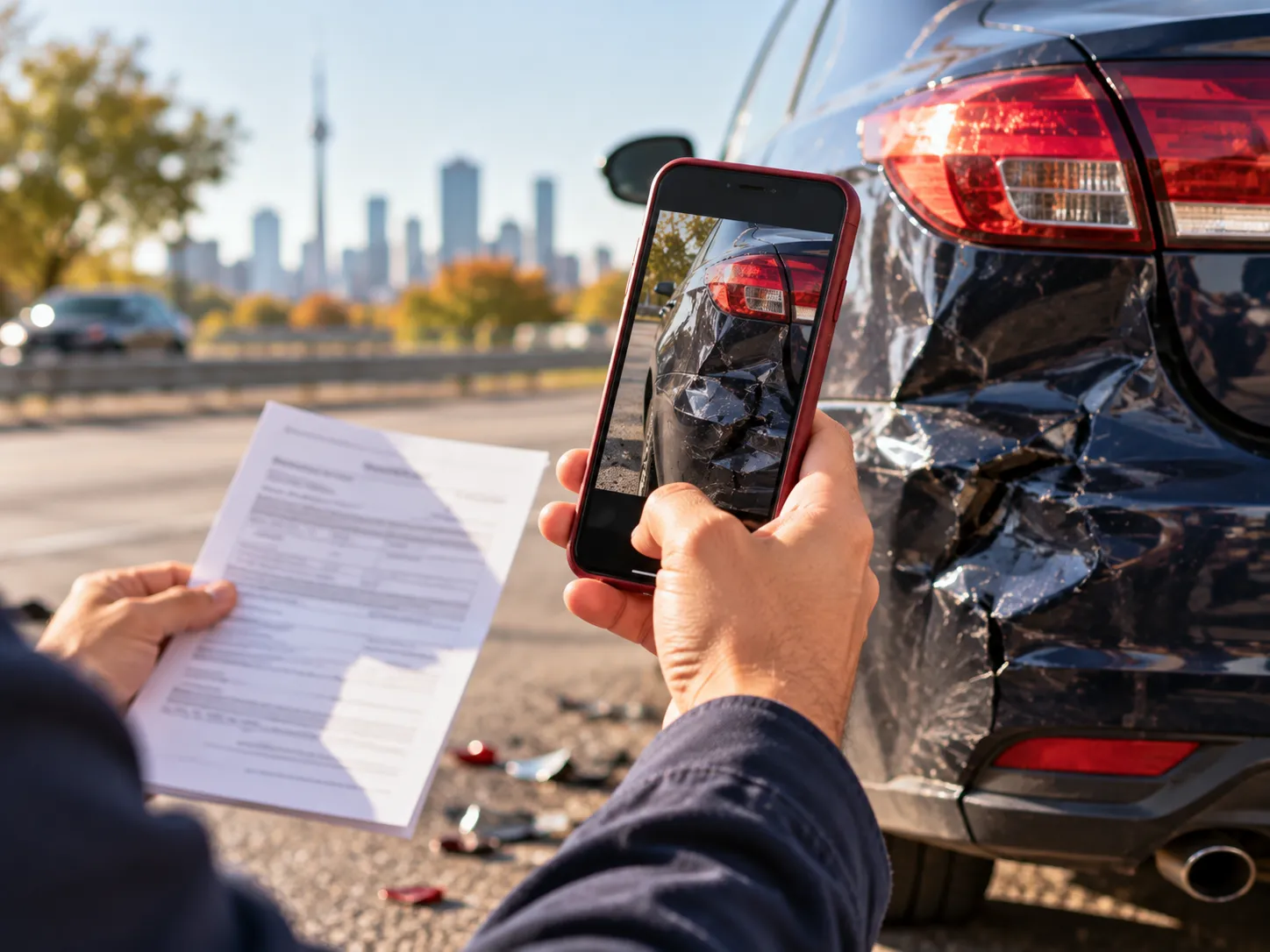
If you are physically able and it is safe, gather evidence while you are still there. Memories fade and vehicles get towed, so this is your best chance.
Photograph all vehicles, the damage, the positions on the road, and the wider scene, including traffic signals, signs, and skid marks.
Capture the conditions: weather, lighting, and any snow or ice, which matters in a GTA winter.
Note the date, the time, and the precise location, including the cross-streets or the highway and direction.
Get the names and contact details of any witnesses, who tend to disappear once everyone drives away.
Save any dashcam footage, and note nearby businesses or homes that may have camera coverage.
Step 4: Exchange information
Exchange names, addresses, phone numbers, driver’s licence numbers, licence plate numbers, and insurance details with the other driver or drivers. For a collision, also note the make, model, and colour of the vehicles. Be businesslike and calm. You do not need to discuss blame to exchange the basic information, and you should not.
Step 5: Notify your insurer within seven days
This is a deadline many people miss. If you intend to claim accident benefits after a motor vehicle collision, Ontario’s rules require you to notify your own auto insurer within seven days of the accident, or as soon as practicable after that. Once the insurer sends you the application forms, you generally have 30 days to complete and return the main application, the OCF-1. These accident benefits, set out in the Statutory Accident Benefits Schedule, are available regardless of who was at fault.
One important update to know: since July 1, 2026, Ontario made several accident benefits optional rather than automatic. Only medical, rehabilitation, and attendant care benefits are now mandatory in every auto policy; income replacement and others depend on the coverage purchased. That makes it more important than ever to report promptly and to understand what your policy actually includes. If your benefits are later denied or cut off, that dispute is decided by the Licence Appeal Tribunal, not a court.
Step 6: Be careful what you say
It is human to apologize or to speculate about what happened. Try not to. Do not admit fault at the scene, and do not give a recorded statement to any insurer, including your own, before you get advice. Ontario decides fault in percentages, and shared fault reduces rather than eliminates a claim, so an off-hand comment can cost you more than you realize. Stick to the facts when you report, and let the evidence speak.
Step 7: Keep records of everything
From day one, start a simple file. Keep every medical record and receipt, a note of every appointment, records of time missed from work and income lost, and a short journal of how the injury affects your daily life. These records are the raw material of a fair claim, and they are far easier to keep as you go than to reconstruct months later.
In the days and weeks after the accident
The first hour matters, but so do the weeks that follow. Keep every medical appointment and follow the treatment plan your providers give you, because consistent care is both how you recover and how the record of your injury is built. See your family doctor even if you were treated at the scene or in an emergency department, so there is a clear thread connecting your symptoms to the accident.
Watch for injuries that surface late. Concussions and other mild traumatic brain injuries can show up as headaches, trouble concentrating, or mood changes days later. Whiplash and soft-tissue injuries often stiffen up over the following days. The emotional aftermath is real too: anxiety about driving, trouble sleeping, and low mood are common after a serious accident, and they are legitimate parts of a claim, so tell your doctor about them rather than toughing it out.
One modern caution: be careful what you post online. Insurers and defence lawyers do look at social media, and a cheerful photo or an offhand comment can be taken out of context to suggest you are less hurt than you are. You do not need to disappear from the internet, but it is wise to avoid posting about the accident, your injuries, or your activities while a claim is developing.
Watch out for the insurance adjuster’s early call
Expect a phone call from an insurance adjuster, sometimes within days. The adjuster is usually friendly and helpful-sounding, and part of the job is to gather information and resolve the file for as little as possible. That is not a criticism, it is simply their role, and it is why you should be careful.
Two requests are worth pausing on. The first is a recorded statement. You are generally not required to give one before getting advice, and what you say can be used to challenge fault or the extent of your injuries later. The second is an early settlement offer, which can arrive before anyone knows how serious your injury really is. Accepting it usually means signing a release that closes the door on any further claim, even if your condition worsens.
The safest approach is simple: be polite, provide only the basic facts you are required to report, and route the substantive conversation through a lawyer. Once a firm is acting for you, the adjuster deals with the firm, and you can focus on getting better.
Step 8: Know the deadlines that can end a claim
“Two years” is the number most people have heard, and it is the general rule: Ontario’s Limitations Act, 2002 sets a basic two-year limit to start most injury lawsuits, running from when you knew or should have known you had a claim. But several deadlines arrive far sooner and are easy to miss:
If you were hurt in a slip and fall on snow or ice on private property, you must give written notice within 60 days under the Occupiers’ Liability Act.
If you fell on a municipal sidewalk or road, written notice to the municipality is generally required within just 10 days.
If you are claiming accident benefits, the seven-day insurer notice and 30-day application deadlines apply.
Because these short clocks can bar a claim before the two-year period is anywhere near up, the safest move after any accident is to get advice early.

Do not forget your vehicle and property
Your injury claim and your vehicle damage are handled separately, and it is easy to lose track of the car in the stress of a medical recovery. Damage to your vehicle is generally dealt with through your own insurer under the property damage part of your policy, on a different track from your accident benefits and any injury lawsuit. Keep the repair estimate, photos of the damage, and any documents about a write-off or the value of the vehicle.
If your car was written off, make sure you understand how its value is being calculated before you accept a payout, and keep copies of everything. None of this replaces your injury claim, but handling it properly keeps you mobile and prevents a separate headache from piling onto your recovery. If anything about the property side feels unfair, mention it when you speak with a lawyer about your injuries.
Special situations to be aware of
A few scenarios have their own wrinkles. If you were a pedestrian or cyclist struck by a vehicle, the July 2026 benefit changes affect which optional benefits may be available to you through a driver’s policy, so early advice matters. If the at-fault driver fled or was uninsured, there are separate avenues and notice requirements to pursue. And if your accident was a slip, trip, or fall rather than a collision, the notice rules above move to the front of the line.
What to do next
Get medical care and keep every record, even for a seemingly minor injury.
Report the collision correctly, to police where required and at a Collision Reporting Centre otherwise.
Notify your insurer within seven days if you intend to claim benefits.
Avoid recorded statements and admissions of fault until you have advice.
Book a free consultation so we can protect your deadlines and handle the insurer for you.
Frequently asked questions
Do I have to call the police after every accident in Ontario? You must report as soon as possible if anyone is injured or if combined damage appears to exceed $5,000. For minor property-only collisions, report at a Collision Reporting Centre, often within 24 hours. How long do I have to tell my insurer? Notify your own auto insurer within seven days of the accident if you intend to claim benefits, or as soon as practicable. The main application, the OCF-1, is generally due within 30 days of receiving the forms. Should I give the insurance company a recorded statement? Not before you get advice. What you say can affect fault and the value of your claim. What if I feel fine after the accident? Get checked anyway. Many injuries surface a day or two later, and a prompt medical record protects both your health and your claim.
Talk to a lawyer, free. If you or someone you love was hurt in an accident in the GTA, we are ready to help you take the right next steps. Get a free case evaluation, with no fee unless we win your case. Past results do not guarantee a similar outcome. Call 416-986-3036, or reach us any time at 905-624-4878. Take Back Control of Your Life.® Click or Call, That’s All!®
Merricks Law Group, Injury Lawyers · 191 The West Mall, Suite 110, Etobicoke, ON M9C 5K8
This article is general information about Ontario law, not legal advice, and reading it does not create a solicitor-client relationship. Every case is different.
Relatable Articles

Limitation Periods for Personal Injury Claims in Ontario

What Is My Personal Injury Case Worth in Ontario?
How to Choose a Personal Injury Lawyer in the GTA